

Access the Gartner® Report:
Market Guide for Infrastructure Monitoring Tools.
Modern IT environments generate large volumes of telemetry across distributed, hybrid and cloud-native architectures. Infrastructure and Operations (I&O) teams must ensure availability, improve resilience and accelerate incident response despite growing complexity.
Download Gartner report to understand how infrastructure monitoring is evolving toward observability, analytics and broader decision support — and what this evolution means for your operating model and tool selection strategy.
Here’s what emerged from our reading of the Gartner report:
- “Infrastructure monitoring tools have become commoditized, with vendors incorporating advanced analytics and machine learning to distinguish themselves within the market.”
- “As mature enterprises adopt cloud-native architectures, I&O teams have shifted their focus from troubleshooting toward root cause analysis in order to enhance resilience.”
- “Business leaders are increasingly influencing procurement decisions, expanding evaluation criteria beyond technical depth toward qualitative and business-oriented outcomes.”
- “Dynamic service discovery, relationship mapping, data exchange and relevant metric selection are becoming critical to improve observability and operational decision-making.”
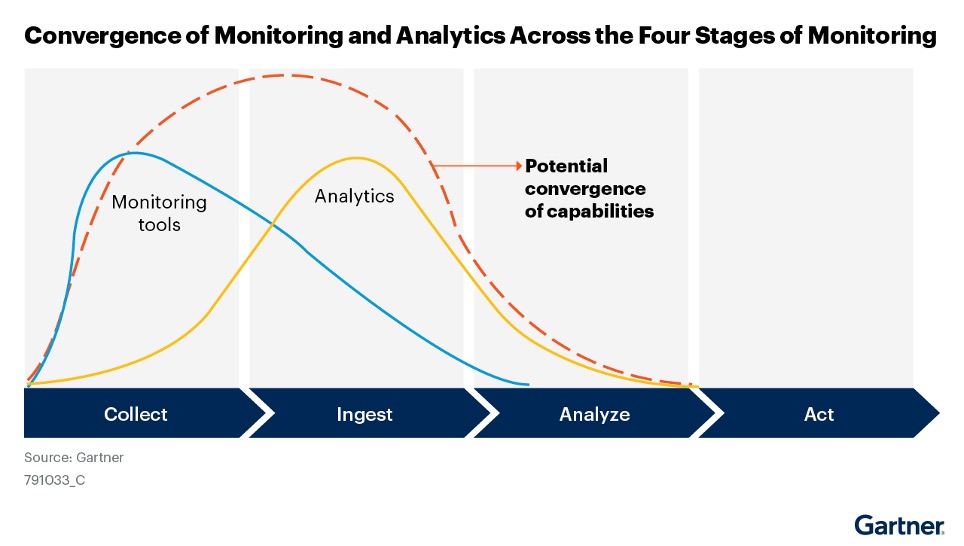
This graphic was published by Gartner, Inc. as a part of a larger research document and should be evaluated in the context of the entire document. The Gartner document is available upon request from Spindox.
Why it matters now
According to Gartner:
“Advanced infrastructure monitoring tools employ data analytics and machine learning to enhance performance by enabling real-time insights, rapid diagnosis and troubleshooting.”
According to Spindox, this shift is redefining the value of monitoring: the advantage is no longer just collecting telemetry, but converting infrastructure signals into faster, cross-functional operational decisions.
High-impact use cases for AI and analytics in Infrastructure Monitoring
Faster incident response
AI- and ML-driven analytics help enterprises proactively detect and resolve problems more quickly, improving MTTD and MTTR and supporting better service availability.
Democratized insights
Expanding target audiences (including SREs and developers) require easier access to telemetry, custom analytics and dashboards, with flexible views tailored to different users.
Better root cause analysis
Good alerting systems can reduce false positives and drive automated root cause analysis, while analytics and correlation reduce event noise.
Stronger business-IT collaboration
Organizations should engage business stakeholders during tool selection and establish dashboards tailored to the audience, including business-centric and service-level views.
Our Key takeaways
Infrastructure monitoring is converging with observability, event intelligence and analytics, while cloud-native architectures are shifting priorities toward resilience, optimization and contextualized insight. Organizations increasingly need monitoring platforms that are analytics-rich, interoperable and usable across multiple personas.
According to Spindox, the next competitive advantage will come from choosing rightsized monitoring tools with strong analytics, flexible integration and governance over metrics — so teams can improve resilience without overengineering the stack or overbuying features.
Ready to explore the next evolution of infrastructure monitoring?
Download the Gartner® Report

GARTNER is a registered trademark and service mark of Gartner, Inc. and/or its affiliates in the U.S. and internationally and is used herein with permission. All rights reserved. Gartner, Inc.
Market Guide for Infrastructure Monitoring Tools. Pankaj Prasad, Mrudula Bangera, Martin Caren. 5 March 2025. The Gartner document is available upon request from Spindox.
Over 100 clients across 13 industries
rely on us.



























We innovate with quality and security, delivering robust and lasting solutions.
We add value to every relationship, thanks to our agility, creativity, and collaborative skills.